Key Takeaways
- Writing is a structured process, not a one-time activity.
- Prewriting is the most important stage for organization and clarity.
- Drafting focuses on ideas, not perfection.
- Revising improves structure and argument strength.
- Editing fixes grammar and technical errors.
- Proofreading removes small surface mistakes.
- Publishing completes the writing cycle and allows feedback.
Writing is not a one-step activity. Strong writing follows a structured process that helps transform ideas into clear, organized, and polished content.
The 7 steps of writing skills provide a proven framework used in schools, universities, and professional writing environments. Whether you are writing an academic essay, blog post, or business document, following these steps ensures clarity, coherence, and quality.
If you are working on structured academic essays, you may also want to understand the 5-paragraph essay format explained in our complete guide to the 5 Paragraph Essay Rule.

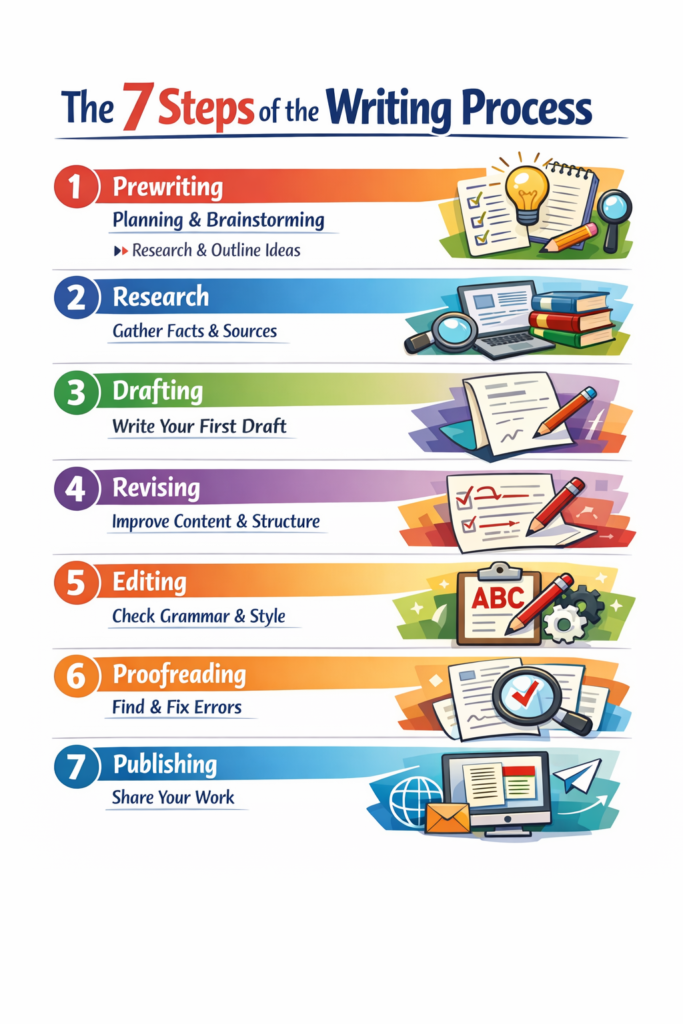
The 7 Steps of the Writing Process

1. Prewriting (Planning and Brainstorming)
Prewriting is the foundation of effective writing.
This stage includes:
- Brainstorming ideas
- Researching your topic
- Identifying your audience
- Clarifying your purpose
- Creating an outline
Why Is Prewriting Important?
Many students skip planning and start drafting immediately. This often results in disorganized paragraphs and weak arguments.
Best Primary and High Schools in Campbelltown NSW 2026
If you are planning body paragraphs, you can use the structure explained in our guide on the PEEL Method (internal link).
Prewriting saves time later by reducing major revisions.
2. Research
Research strengthens your content with facts, examples, and supporting evidence.
At the university level, research involves:
Top High Schools in Perth
- Using academic databases
- Evaluating credible sources
- Taking organized notes
- Citing properly
Without research, writing often lacks authority and depth.
3. Drafting
Drafting is where your ideas become full sentences and paragraphs.
Focus on:
- Writing your introduction
- Developing structured body paragraphs
- Supporting your thesis
- Creating a conclusion
At this stage, do not worry about grammar or perfection. The goal is to complete your first version.
If you’re writing a structured essay, drafting often follows the introduction–body–conclusion format similar to the Five Paragraph Essay model.
4. Revising
Revising focuses on improving clarity, structure, and logical flow.
Ask yourself:
- Is my thesis clear?
- Does each paragraph support the main idea?
- Are transitions smooth?
- Is the argument convincing?
Revising improves content quality, not just grammar.
5. Editing
Editing corrects technical issues such as:
- Grammar
- Sentence structure
- Word choice
- Punctuation
- Formatting
Editing ensures professionalism and readability.
If you want a complete breakdown, read our guide on the 12 Basic Steps of Editing (internal link when published).
6. Proofreading
Proofreading is the final review stage.
It focuses only on:
- Spelling mistakes
- Typographical errors
- Minor punctuation issues
Editing improves writing quality.
Proofreading ensures surface accuracy.
7. Publishing or Submitting
The final step is sharing your work.
This may involve:
- Submitting an academic essay
- Publishing a blog post
- Sending a report
Posting content online
For content creators and marketers, this stage also includes SEO optimization and formatting.
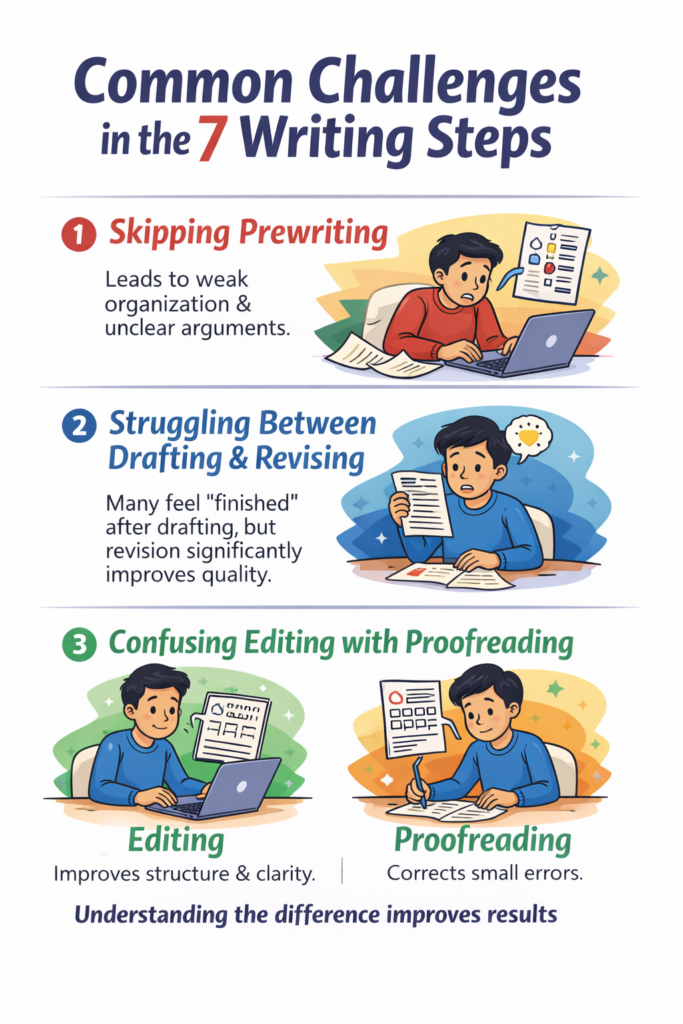
Common Challenges in the 7 Writing Steps

Skipping Prewriting
Leads to weak organization and unclear arguments.
Struggling Between Drafting and Revising
Many writers feel “finished” after drafting, but revision significantly improves quality.
Confusing Editing with Proofreading
Editing improves structure and clarity.
Proofreading corrects small errors.
Understanding the difference improves results.
5 Steps vs 7 Steps of Writing: Which Is Better?
Some educational systems use a 5-step model. Typically, they combine:
- Research + Prewriting
- Editing + Proofreading
The 7-step model is more detailed and better for academic and professional writing because it clearly separates major revision from minor corrections.
7 Steps of Academic Essay Writing (University Level)
For university students, the steps may look like this:
- Analyze the assignment
- Conduct research
- Develop a thesis statement
- Draft structured paragraphs
- Revise argument clarity
- Edit citations and grammar
- Proofread before submission
Combining this process with strong paragraph structure improves grades significantly.
7 Steps for Elementary Students
For younger learners, the steps are simplified:
- Think
- Plan
- Write
- Check
- Fix
- Share
- Celebrate
The structure remains the same — only the terminology changes.
Professional Writing Workflow for Content Marketers
In professional writing, the 7 steps adapt to:
- Keyword research
- Content outline
- SEO drafting
- Structural revision
- Optimization
- Editing
- Publishing and promotion
This structured workflow increases content quality and search visibility.
Frequently Asked Question For 7 Steps of Writing
What are the 7 stages of the writing process?
Why is the prewriting stage critical?
What is the difference between editing and proofreading?
Which is better: 5 steps or 7 steps of writing?
Final Thoughts
Mastering the 7 steps of writing skills gives you a reliable roadmap from idea to final submission. Whether you’re writing school essays, university assignments, or professional content, following this structured approach ensures clarity, organization, and higher-quality results.
To further strengthen your writing:
- Learn proper essay structure using the 5-paragraph model
- Improve paragraph development with the PEEL method
- Apply systematic editing before submission
Together, these skills build long-term writing confidence and authority.
Author
Rajesh Kumar Sharma is the founder of SchoolsFinders, a platform dedicated to helping parents and students make smarter education choices across Australia. With a strong focus on school rankings, academic resources, and insightful comparisons, Rajesh aims to simplify the process of finding the best-fit schools. His passion for education and commitment to accuracy ensure that SchoolsFinders remains a trusted source for families navigating their educational journey.